Opening Sentence
Update the opening line to your essay and be prepared to share this PLUS the second sentence of your essay. Please write multiple versions of these first two sentences
Opening sentences:
Initial starting sentences:
- You have two days, 48 hours to collect everything you need to survive for the rest of your life, are you ready?
- It was not long ago when I was sitting there, in my home, just like you.
- Just like you, I had a new innocence about me, completely unaware that the world around us was soon going to change forever.
Edited starting sentences:
- You only had 2 days, 48 hours to pack up your whole life, are you be ready? Everything that you need to survive in one suitcase. Everything that holds large significance to you
- If you were told that you had to flee your home immediately would you be ready? Would you pack the essentials of food and clothes? Or would you choose personal comforts to sustain your lifestyle?
- Innocence surrounds me like light, suffocating the darkness. Completely unaware that the life we know is coming to an end. A domicile being thrust into a nomadic lifestyle. From structure and stability into chaos and uncertainty.
- I ponder on something beautiful, if through all of this pain and suffering new challenges and opportunities for design can arise.
- It was not long ago when I was sitting there, in my home, just like you.
Introduction Draft
A domicile thrust into a nomadic lifestyle. From structure and stability into chaos and uncertainty. If you were told that you had to leave your home immediately would you be ready? Would you pack the essentials of food and clothes? Or would you choose personal comforts to sustain your lifestyle? We, as young adults, are forced to make so many decisions about our future without being fully aware of the consequences these could have. Not getting the job, getting the job then losing the job, failing in the study, changing interests and changing education, and so on. But one thing that should always be stable to us wherever we may go, and encourage the decisions that we make, is the comfort and stability of the home.
Visual Mapping
- Please complete an updated ‘visual map of contexts’ (the class exercise we completed in week 2 to share) with the class via screen share.
- Include your research question in this map
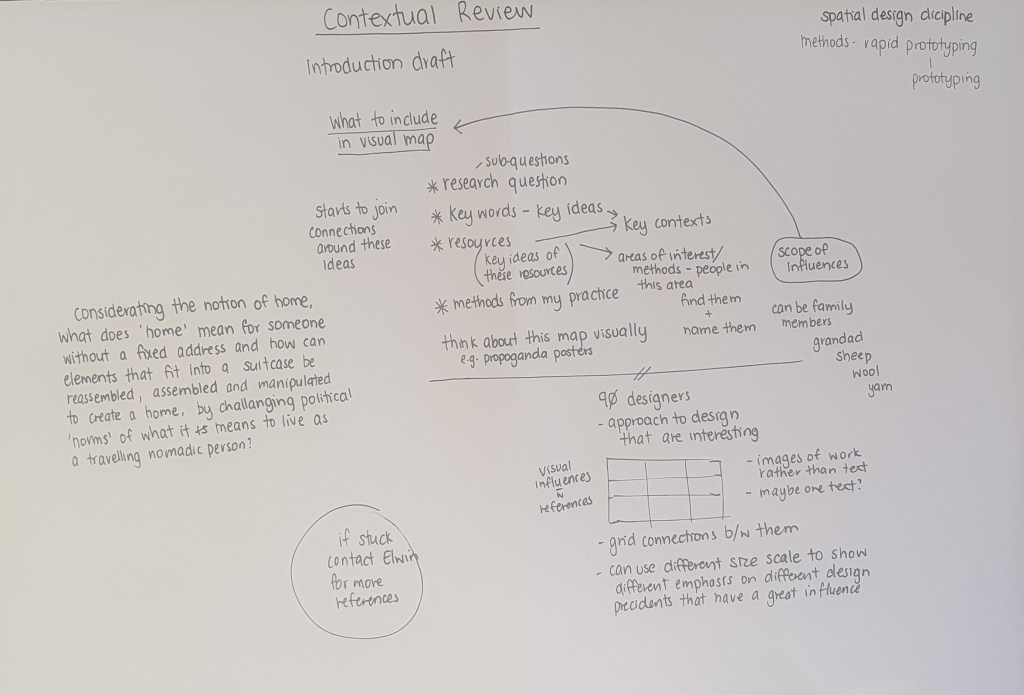
- In addition to ten key texts/artifacts that you have read about (and hopefully assessed and reflected upon) that are shaping your thinking around your research project.
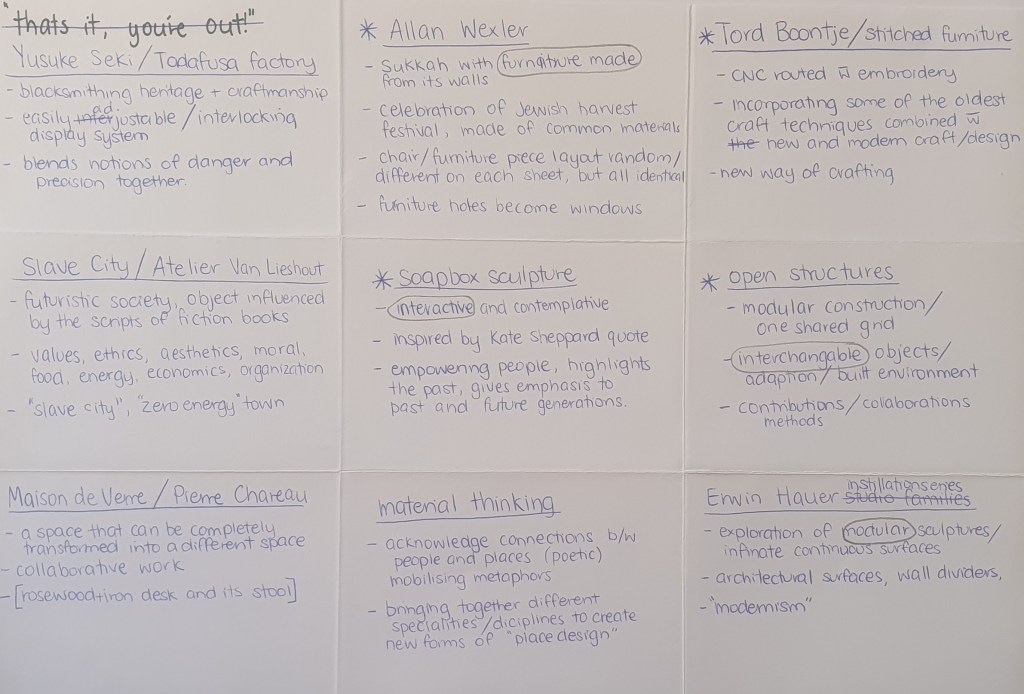
I have made a grid of 9 physical sculptures/works/designs and have a strong connection to both the physical properties of my desired research project outcome as well as the theory behind what it is I am interested in researching. I have added 4 asterisks next to the four projects that I have a strong connection with and ones that I feel relate very strongly to my research area.
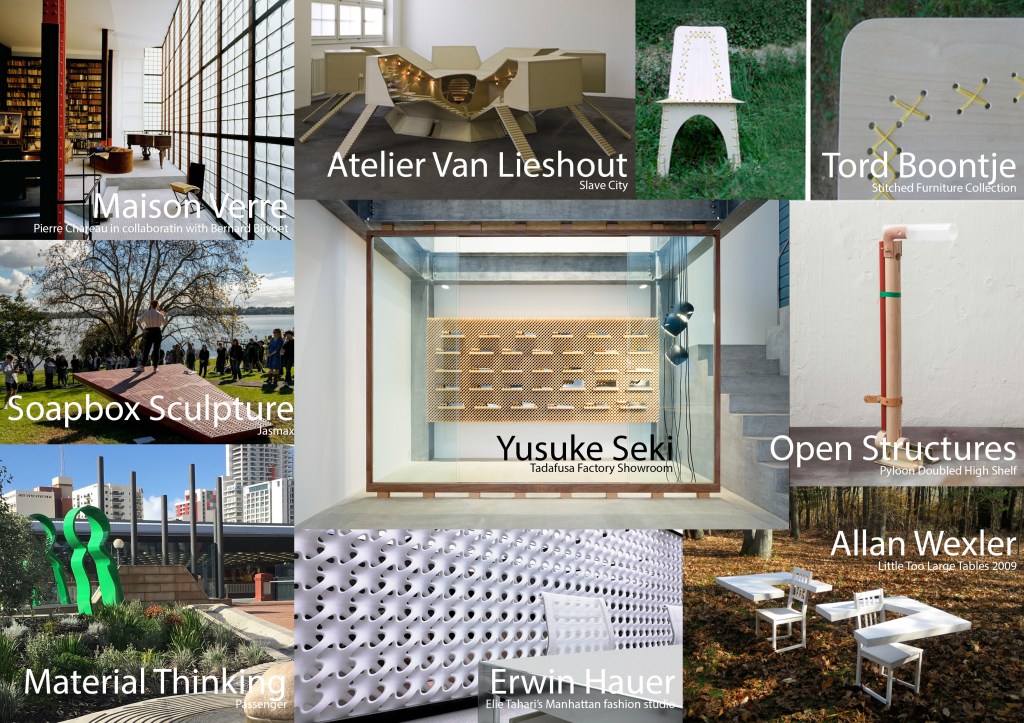
From left to right, top to bottom:
1. Verre, Maison. “Pierre Chareau in collaboratin with Bernard Bijvoet.” Hidden Architecture. http://hiddenarchitecture.net/maison-verre/ (Retrieved, 26 May 2020)
2. Atelier Van Lieshout. “Slave City.” ArchDaily. https://www.archdaily.com/30114/slave-city-atelier-van-lieshout (Retrieved, 26 May 2020)
3. Boontje, Tord. “Stitched Furniture Collection.” Ponoko. https://www.ponoko.com/blog/2011/08/06/tord-boontje-stitched-collection (Retrieved, 26 May 2020)
4. Jasmax. “Soapbox Sculpture.” ArchiPro. https://archipro.co.nz/projects/soapbox-sculpture-jasmax (Retrieved, 26 May 2020)
5. Seki, Yusuke. “Tadafusa Factory Showroom.” Yusuke Seki. http://yusukeseki.com/works/tadafusa-factory-showroom/ (Retrieved, 26 May 2020).
6. Open Structures. “Pyloon Doubled High Shelf.” Open Structures. https://www.openstructures.net/apps/a636 (Retrieved, 26 May 2020)
7. Material Thinking. “Passenger.” Material Thinking. https://www.materialthinking.com.au/work (Retrieved, 26 ay 2020)
8. Hauer, Erwin. “Elie Tahari’s Manhattan fashion studios.” Erwin Hauer. http://erwinhauer.com/eh/installations/elie-taharis-manhattan-fashion-studios-5th-avenue-and-43rd.-street (Retrieved, 26 May 2020)
9. Wexler, Allan. “Little Too Large Tables 2009.” Allan Wexler. http://www.allanwexlerstudio.com/projects/little-too-large-tables-2009 (Retrieved, 26 May 2020)
- Think about ways your visual map can connect/build bridges between these different contexts. What do they have in common?
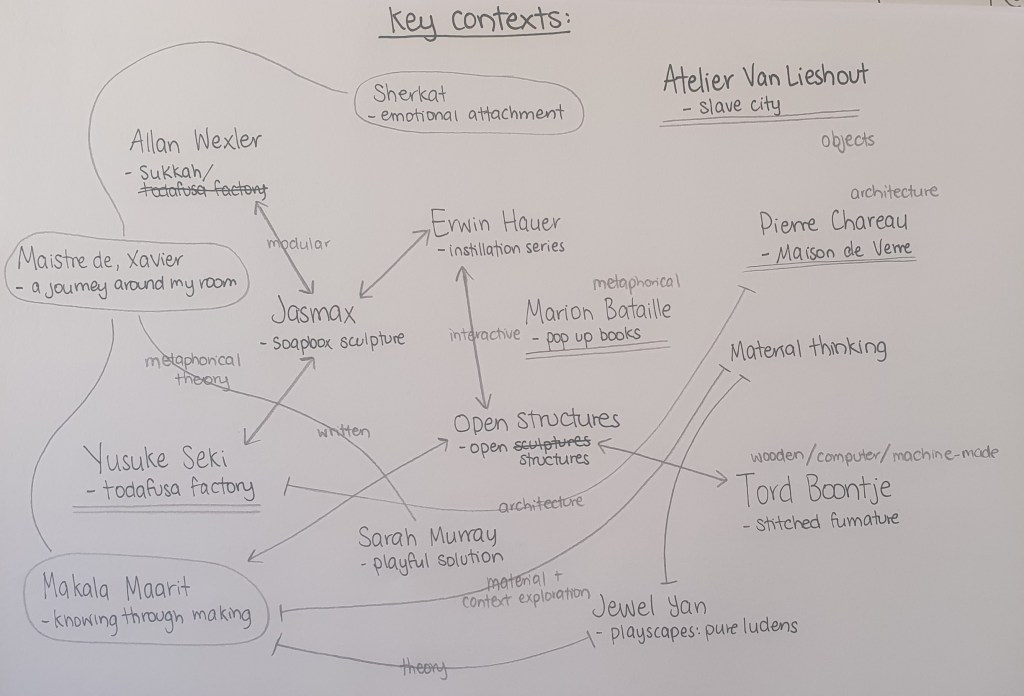
- How do the concepts they explore relate to your research question?
- How have designers addressed some similar social or cultural issues before you and what can you learn from looking at their creative practice.
Taking an A4 page I decided to list down the references that I have collected this far and started to think about how these relate to each other and what connections and similarities these contexts have with each other and in relation to my own works. I have drawn lines between different texts and works and I even started to write up works that help to join these together, words like; metaphorical, interactive, theory, material, exploration, and objects to list a few.
 Georgia Christina Grace