I was really interested to see how clear and strong my annotation was in the eyes of someone else and how they interpreted what I had written. I also got very stuck when writing my summary because I felt like I was writing word for word what the speaker was saying so this I found the most challenging in the task.
It was really helpful the feedback I got in terms of the annotation as it showed that indeed my ideas were there, but they just weren’t as clear as they should have been and with a bit more refinement this would be much more understandable and create a strong base annotation for this paper.

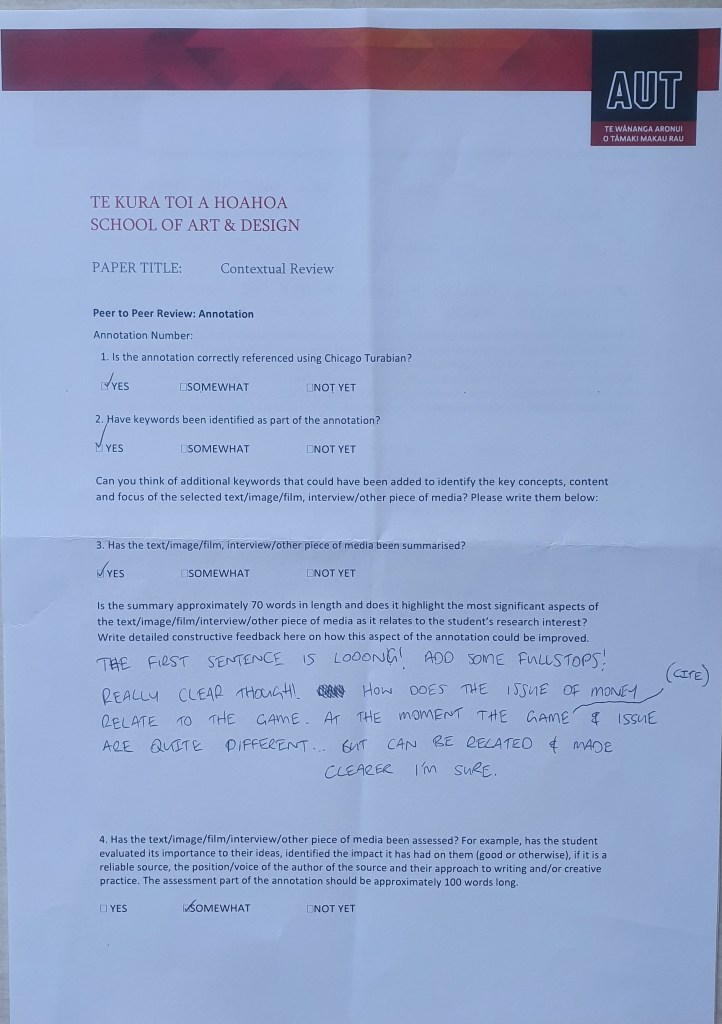
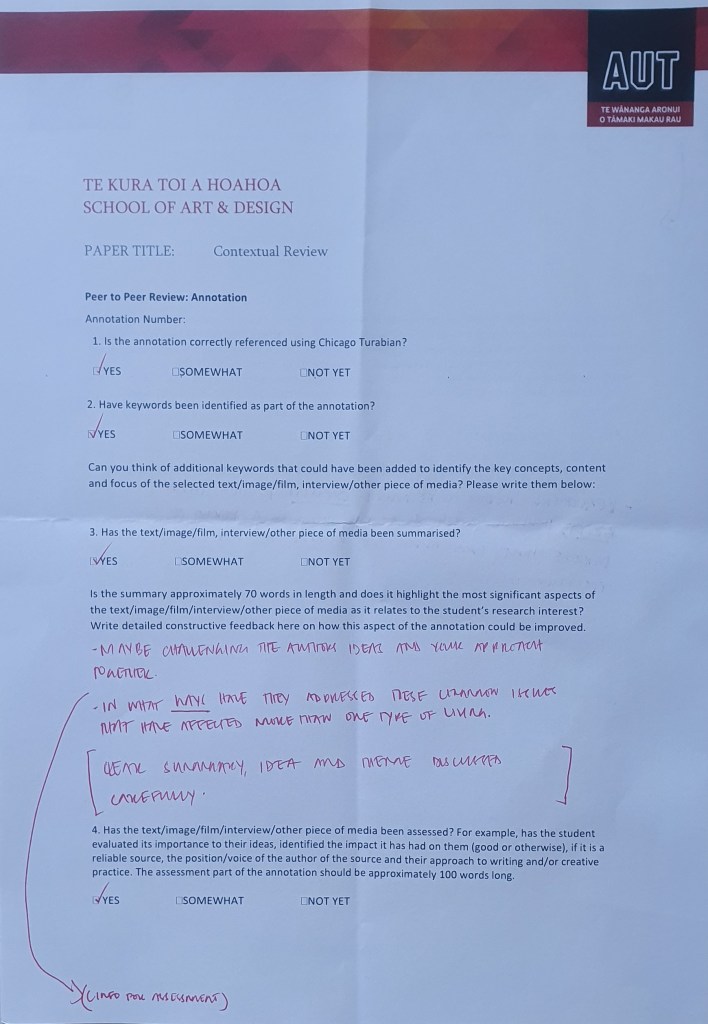
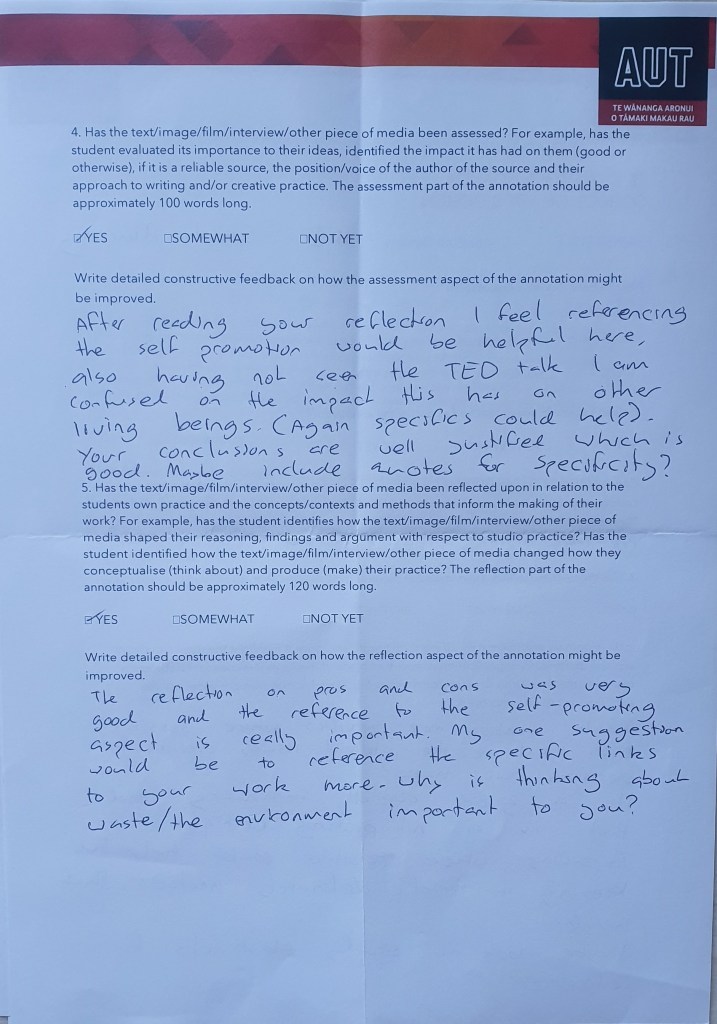
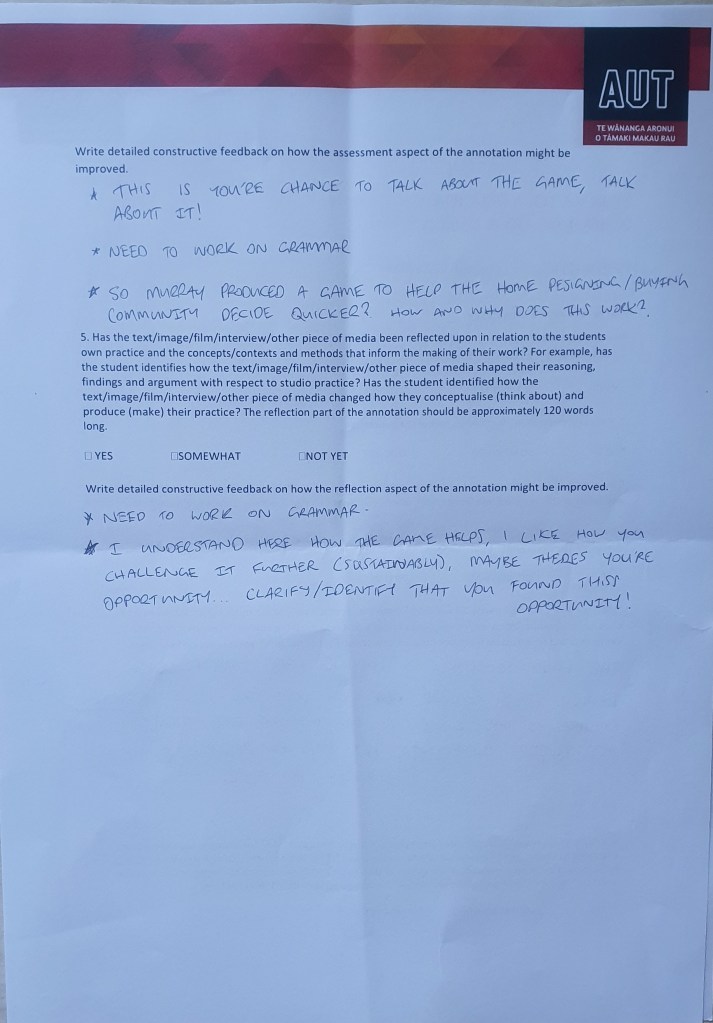

Summary
- Really long sentence, add full stops
- Money issue relate to the game itself
- How the game and money/issues can be related
- What are the political issues driving the decisions I make
Assessment
- Talk about the game
- Produced the game to help the buying community to buy quicker, how and why?
- Confused the impact this has on other living beings
- Be more specific- quotes or direct reference
Reflection
- Clarify/identify that I have found this opportunity to challenge the sustainability even further
- Address specific links in my work more – why Is thinking about waste/environment important to me?
Reference:
Sarah Murray, “A playful solution to the housing crisis”, December 2017 in Sydney, Australia. TED video, 10:42, Sarah Murray: A playful solution to the housing crisis
Keywords:
- Homelessness
- Game
- house design (architecture)
- Cost efficient
- Waste conscious
Summary:
In this TED talk the topics that are the focus of the discussion are issues surrounding the housing crisis, and how creating a “game” that allows people to pick and choose their home will help diminish this. By being able to create a home they can choose how their home will look and the game will tell them how much it will cost to make this happen. This can help reduce the amount of people who are without houses due to the fast nature of construction, eliminating weather as being a determining factor for how long the build takes. As the modular structures are constructed off-site in a building they are then transported and assembled on-site. Murray addresses the political issues of money and how this is a driver in the decisions that we make, how we are less likely to want to do something (even if it is better for the environment) if it is going to cost a substantial amount. She also addresses a social issue of the housing crisis and how many people are without homes due to the expensive nature of building their own home, in both time and money.
Assessment:
As the housing crisis is a huge issue all around the world today, more in particularly in heavily populated cities, as this is where everyone wants to live, and this causes prices to rise and availability to drop. Murray and her team produced this home-building game to target “would be homeowners” so they are able to control what their potential home will look like and how much it will cost to achieve this. This information is somewhat reliable since she talks about how this game is improving the numbers of people who are without homes. She does this using numbers and data that they have collected through the game and the surrounding community. Murray throughout the text gets progressively more excited when taking about the housing issues and what her business has been doing to minimize this. It is because of this that the text is very subjective, because Murray is suggesting that the game is the only way and the best way to overcome the housing crisis issue (as a promotion to her business). However, I do agree with the ideas that she is trying to make it easier for first home buyers to get a house, as well as the way she is going about doing this to minimize cost and waste so not only do the humans benefit but so does the planet.
Reflection:
All in all, I found this source very helpful as a starting point to generate even more ideas about how other people in the industry are thinking about how what they are doing is affecting things that is going on around them. I also found it very helpful to see how all these ideas of how money, time, waste, planet and humans can link together in design and be utilized in a way that is better for most. However, as this was a very subjective and promotive text, I was somewhat disappointed that the negative side was never touched on even slightly, how much material of what they use is recycled, how do they handle the left-over material that they did not use? This is something that I would like to investigate in my research, to see how industry offcuts can be reused and repurposed instead of going into the bin. They are instead used to make a vessel and structure for a nomadic person to live off.
 Georgia Christina Grace